
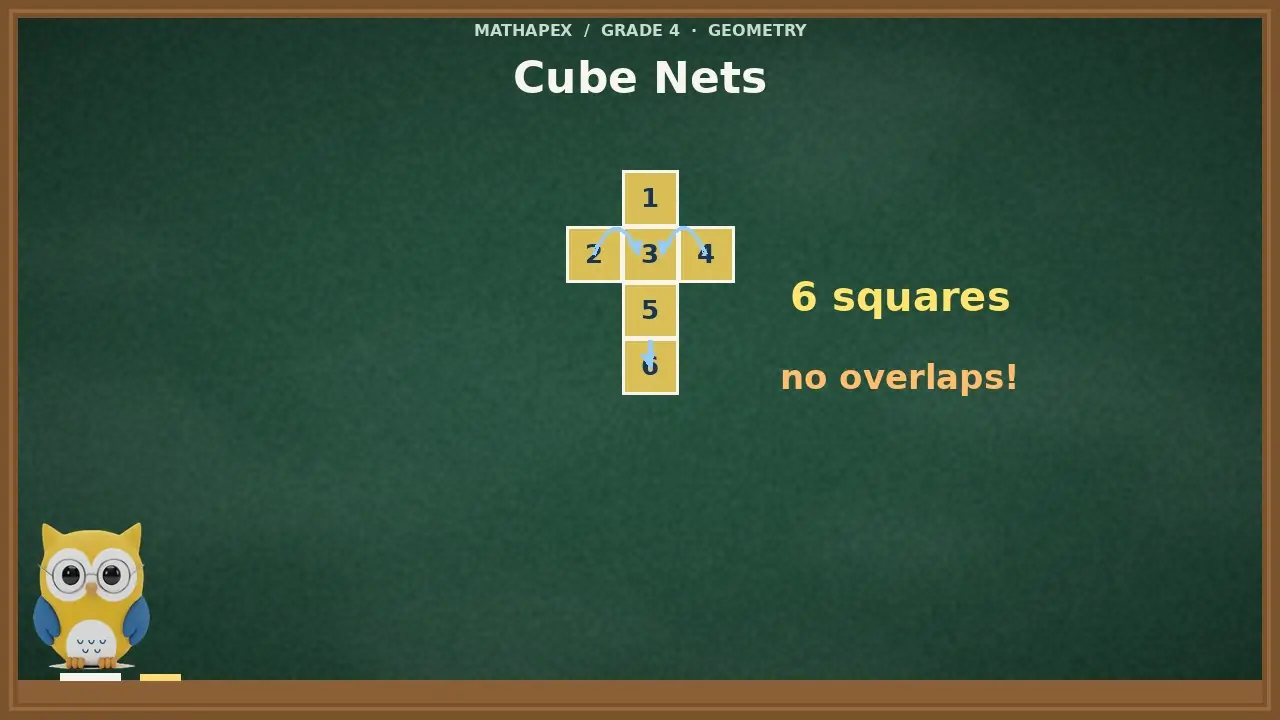
A cube net is the surface of a cube unfolded flat: six equal squares that fold up into a cube with no gaps and no overlaps. There are exactly 11 different cube nets. Shapes that are just rotations or mirror images of each other count as the same net.
Fourth graders are asked to spot these nets, draw their own, and predict which faces end up opposite each other once the net is folded. This article shows how to do that without guessing: two quick checks, a worked example, and a hands-on activity.
The cube: faces, edges, and vertices
Before looking at nets, it helps to know the cube itself:
- 6 faces, all equal squares
- 12 edges: 4 around the top, 4 around the bottom, and 4 going up the sides
- 8 vertices (corners): 4 on top and 4 on the bottom
Exactly three faces meet at every vertex. Keep that fact in mind, because it explains why some shapes can never fold into a cube.
What is a cube net?
Cut a paper cube along some of its edges, flatten it out, and you have a net. The best-known one is the cross in the picture above: a column of four squares with one square on each side.
The 11 nets fall into rough groups. Six of them contain a straight row of four squares. In four nets the longest row is three squares, and one looks like a staircase of two-square steps. None of the nets has more than four squares in a straight row.
How to check a net
- Exactly six squares? A cube has six faces, so its net needs six squares, not five or seven.
- No 2-by-2 block. Four squares that meet at one point would all have to meet at one vertex of the cube, and only three faces meet there.
- Never more than four squares in a row. A row of four wraps once around the cube. A fifth square would land on top of the first one.
- Fold it. Checks 2 and 3 rule out many shapes, but not all of them: some shapes pass both and still do not make a cube. The final test is folding, either in your head (pick one square as the bottom and fold its neighbors up one at a time) or with scissors and paper. If two squares land on the same face, it is not a net.
Which faces end up opposite?
A handy rule for opposite faces: in a straight row, two squares are opposite each other when there is exactly one square between them.
In the cross above, squares 1, 3, 5, and 6 form the column. Square 3 sits between 1 and 5, so 1 and 5 are opposite. Square 5 sits between 3 and 6, so 3 and 6 are opposite. Squares 2 and 4 have square 3 between them. That gives all three pairs: 1 and 5, 3 and 6, 2 and 4. Every face has exactly one opposite face. (The numbers in the cross are only labels, not the dots of a die.) In some other nets a pair does not sit in a straight row; then folding in your head settles it.
On a standard die, opposite faces always add up to 7: 1 and 6, 2 and 5, 3 and 4. If a 3 is on top, a 4 is on the bottom.
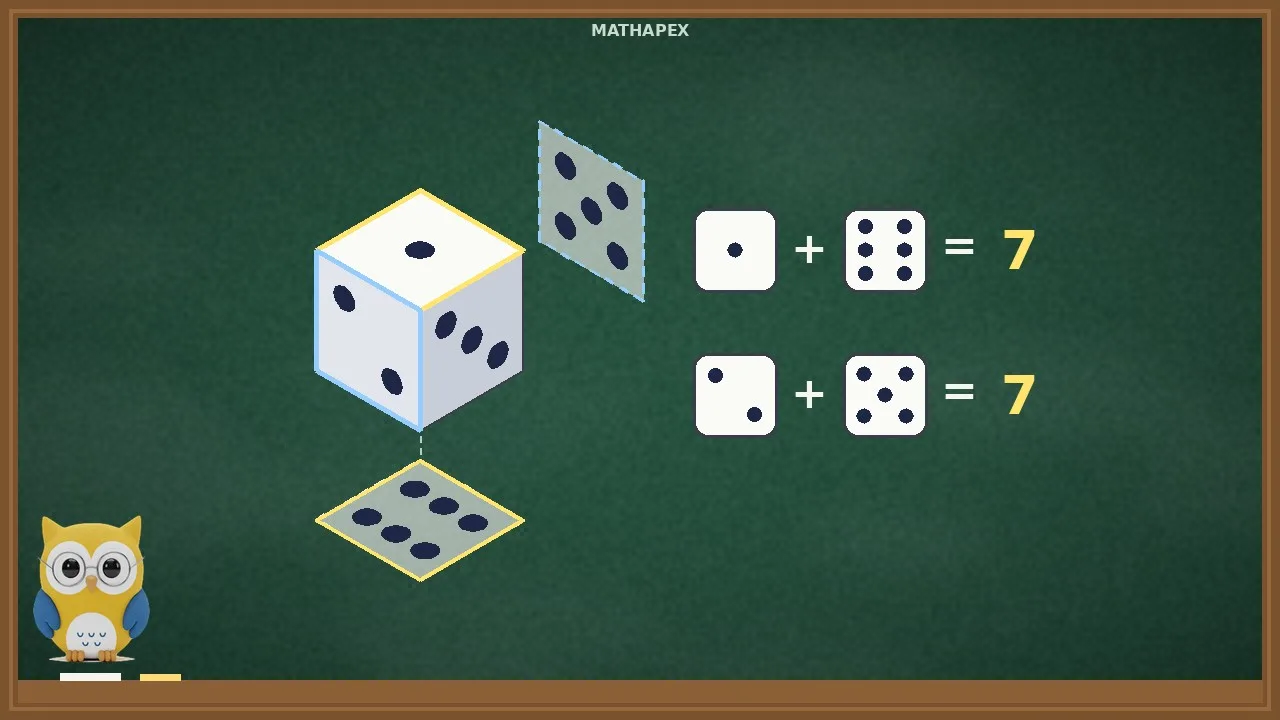
Put the two rules together to number a die net: first find the three pairs of opposite squares, then give each pair two numbers that add up to 7. The video on opposite faces of a die shows the rule with a real die.
Common mistakes
- Next to each other is not opposite. Two squares that share an edge in the net always end up side by side on the cube, never opposite.
- The 2-by-2 block. It looks neat and compact, so children often accept it. One folding attempt shows that it cannot close.
- Rows that are too long. Five or six squares in a row will not make a cube, even though the number of squares may be right.
- The wrong sum. Some children pair the 2 with the 6. With the rule of 7, the face opposite the 2 is the 5.
The cube among other solids
A cube is a special rectangular prism (also called a cuboid). A rectangular prism also has 6 faces, 12 edges, and 8 vertices, but its faces are rectangles. A square pyramid has 5 faces, 8 edges, and 5 vertices. A sphere, cylinder, and cone have curved surfaces: a sphere has no edges and no vertices, a cylinder has two circular faces and no vertices, and a cone has one circular face and a point at the top.
Try it at home
- Make a net. Draw a net with 1-inch squares on grid paper, cut it out, and fold it.
- Color the opposite faces. Before folding, color each pair of opposite squares the same color. If the prediction is right, the finished cube shows three colors, each on two opposite faces.
- Try a shape that fails. Cut out a 2-by-2 block too and try to fold it. Children remember the rule much better after they see it fail with their own hands.
To count the cubes in a stacked building, watch Cube Buildings.
Keep practicing
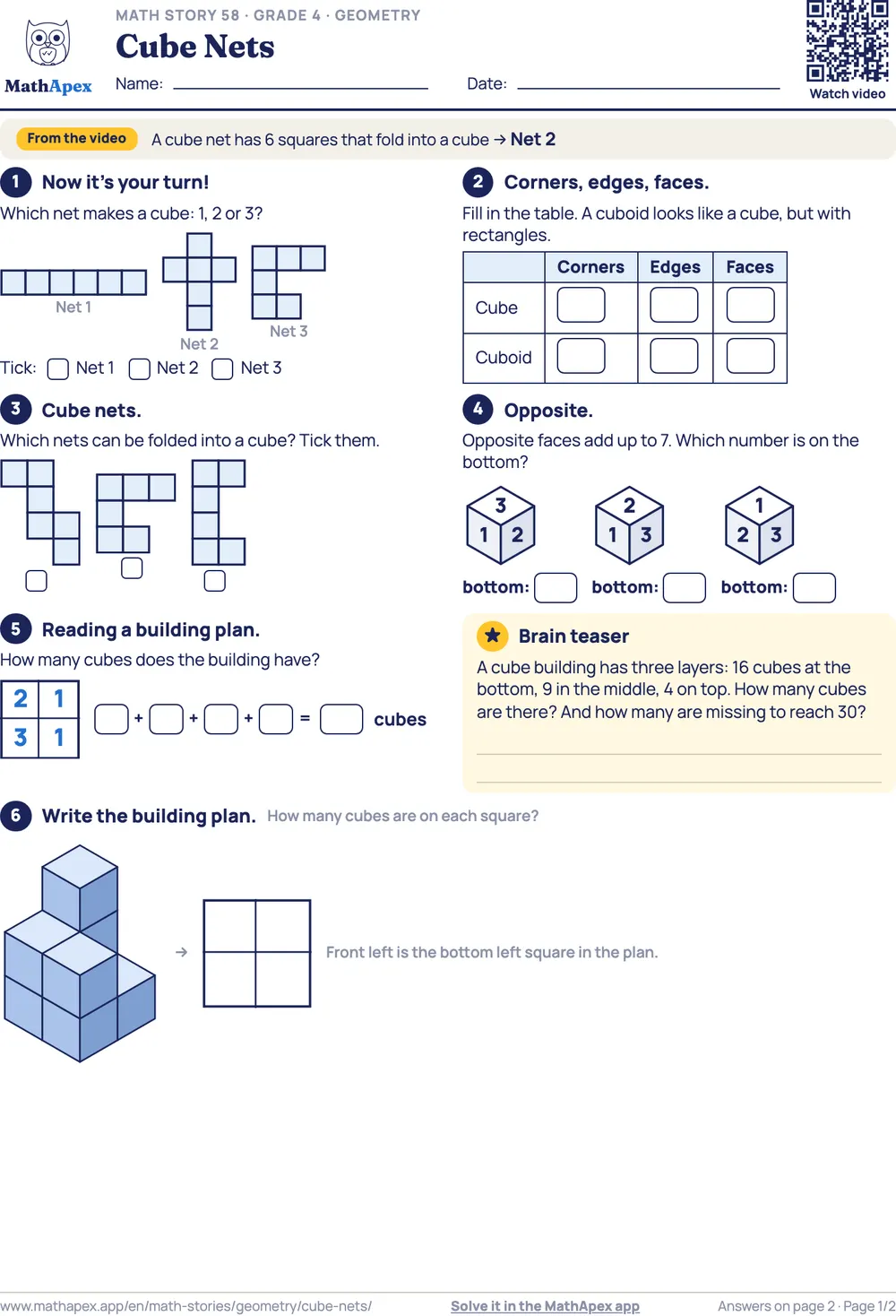
The videos Cube Nets and The Cube explain nets, faces, edges, and vertices as short stories. To go with them, there are grade 4 geometry worksheets with answers on cube nets and opposite faces: spotting nets, filling in a table of corners, edges, and faces, and working out the number on the bottom of a die.
A good closing question: “Which face is opposite the 2, and how do you know?” A child who answers with the one-square-between rule, or by describing a fold, has understood the idea.