
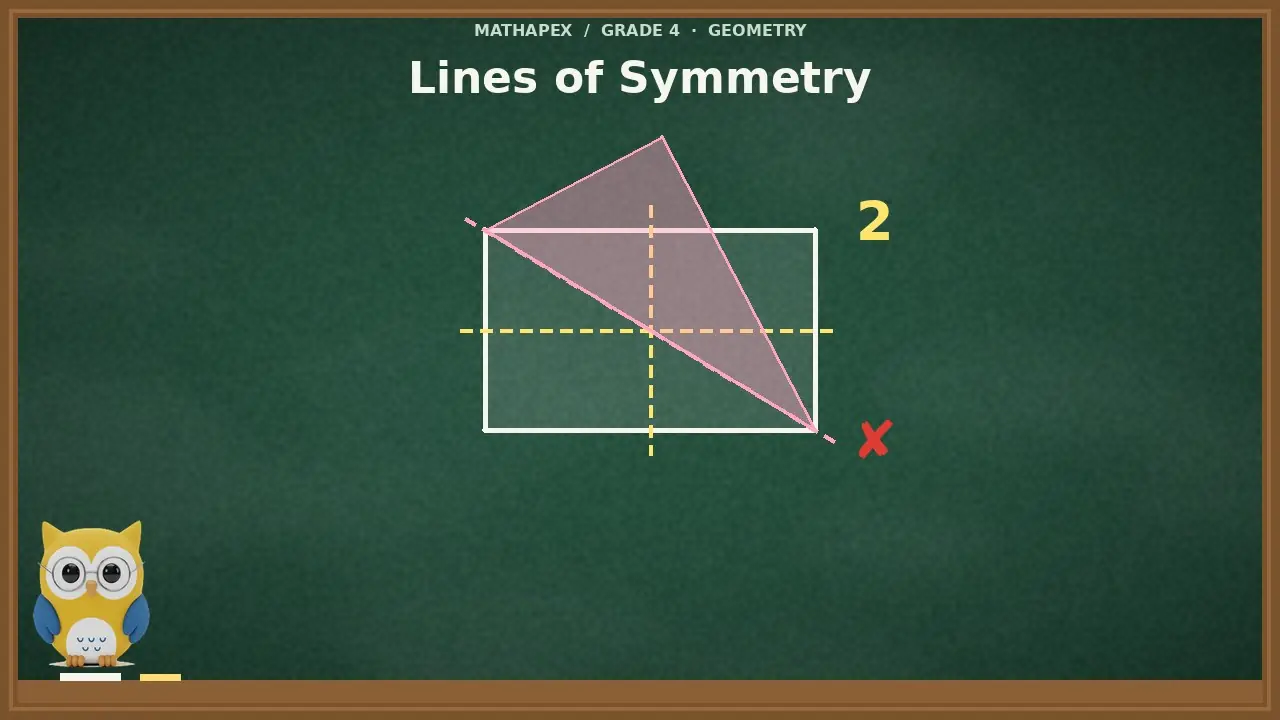
A line of symmetry splits a shape into two halves that are exact mirror images. If you fold the shape along that line, the two halves land perfectly on top of each other. A rectangle has two lines of symmetry, a square has four, and a circle has infinitely many.
Most fourth graders can repeat that definition. The tricky part comes when they have to find every line of symmetry in a shape, or reflect a shape on grid paper. Below are two quick tests children can use, the mistakes that come up again and again, a worked example for reflecting points and shapes, and a short hands-on activity.
Two ways to test a line of symmetry
- The fold test. Fold the shape along the line you suspect, either on real paper or in your head. If both halves match with nothing sticking out, the line is a line of symmetry.
- The mirror test. Stand a small mirror upright on the line. If the reflection completes the visible half into the whole shape, you have found a line of symmetry.
Both tests come down to one rule: every point on one side needs a partner on the other side, the same distance from the line. “Roughly the same” does not count.
Worked example: how many lines of symmetry does a rectangle have?
A rectangle that is not a square has two lines of symmetry: one vertical and one horizontal, each running through the middle.
Many children expect a third line along the diagonal. The chalkboard frame above shows why that fails. Fold a rectangle along its diagonal and two corners stick out past the edges. The halves have the same area, but they do not land on top of each other, so the diagonal is not a line of symmetry.
A square is different. Because all four sides are equal, the diagonals work too. That gives a square four lines of symmetry: two through the midpoints of opposite sides and two through opposite corners.
For comparison:
- equilateral triangle: 3 lines
- isosceles triangle that is not equilateral: 1 line
- regular hexagon: 6 lines
- heart: 1 line
- circle: infinitely many, because every line through the center splits it into two matching halves
Common mistakes
- Counting the diagonal of a rectangle. The most common error by far. One sheet of paper and the fold test settle it in seconds.
- Counting the same line twice. The vertical line through a square is one line, even though it crosses the top and the bottom edge. Drawing each line as soon as it is found keeps the count honest.
- Turning instead of folding. The letters Z, N and S look balanced, but their halves only match after a half turn. That is rotational symmetry, not line symmetry: folding does not make the halves meet.
- Looking only for vertical lines. E has no vertical line of symmetry but does have a horizontal one. H has both.
Reflecting a point on grid paper
On grid paper, a reflection can be counted. For a vertical line of symmetry, the rule is: the mirror point is on the other side of the line, the same distance away, and in the same row.
If a point is 3 squares to the left of a vertical line of symmetry, its mirror point is 3 squares to the right. The two points are 3 + 3 = 6 squares apart. It works backward, too: if a point and its mirror point are 10 squares apart, each one is 10 ÷ 2 = 5 squares from the line.
The video The Mirror Point walks through this counting step by step.
Reflecting and completing a shape
To reflect a shape made of squares, give every square a twin: on the other side of the line, the same distance away, in the same row. Start with the squares that touch the line, because their twins touch it too. Then move outward one column at a time.
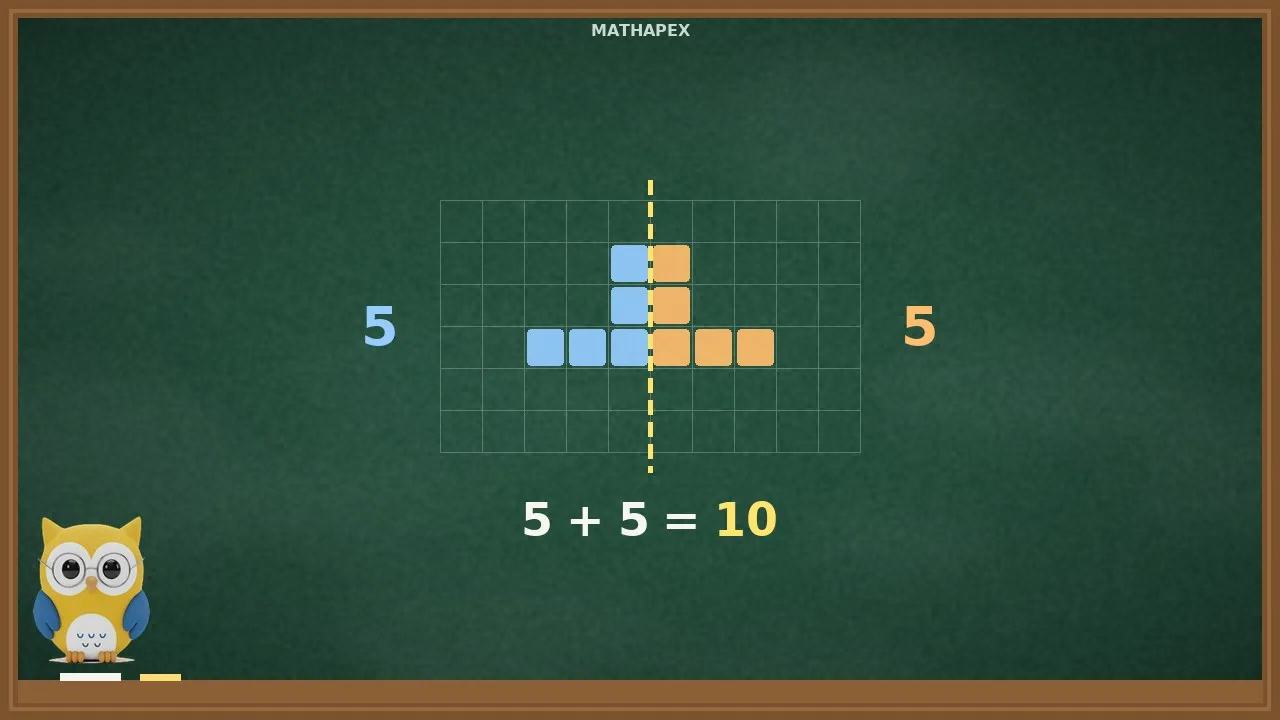
In this example, the left half has 5 squares. The reflection adds 5 more, so the whole shape has 5 + 5 = 10 squares. That sum doubles as a check: if the reflected half does not have the same number of squares as the original, one is missing or one is extra. The video Mirror and Complete shows the shape being built square by square.
For slanted edges, reflect only the corner points, then connect them with a ruler.
A 5-minute activity for home
- Fold and cut. Fold a sheet of paper once, cut half a shape along the fold (half a heart or half a tree), and open it. The fold is the line of symmetry.
- Mirror on letters. Use a small mirror to check which capital letters have a line of symmetry. A, M and T have a vertical one, E has a horizontal one, H has both, and F and Z have none.
- Symmetry hunt. Look around the house or yard for symmetrical things: a window, a butterfly, a leaf. How many lines of symmetry does each one have?
Keep practicing
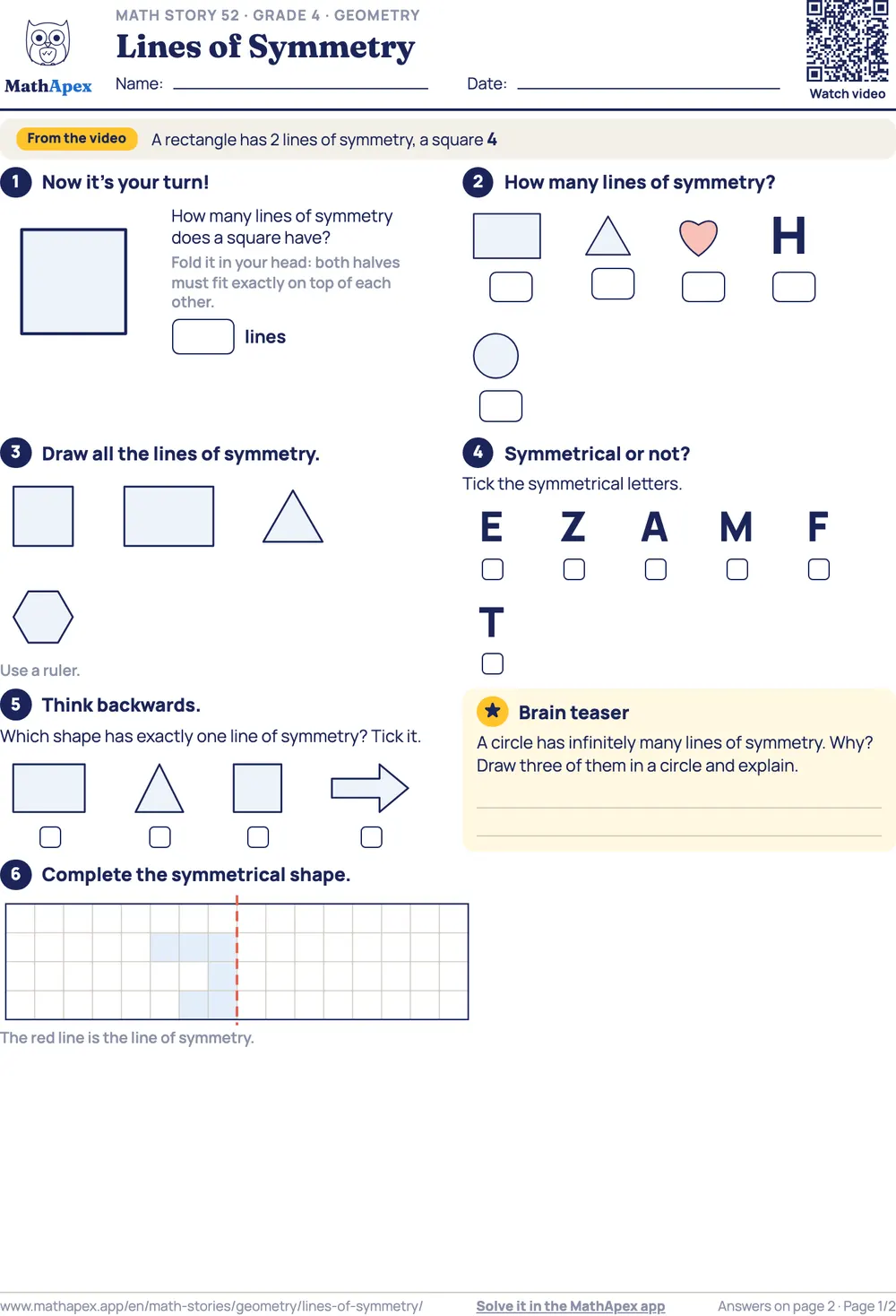
The video Lines of Symmetry tells the rectangle example from this article as a short story. For all three videos there are grade 4 geometry worksheets with answers: counting lines of symmetry, drawing them in, checking off the symmetrical letters, and completing a shape.
A good way to end any practice session is one question: “How do you know that is a line of symmetry?” A child who answers with the fold test has understood the idea.