
When a child says, “I’m bad at math,” another page of sums may feel like another chance to be wrong. A short game can offer a different starting point: What can I work out on this turn? The arithmetic still matters, but the task feels smaller and there is a natural reason to try again.
Math games are not a shortcut around learning, and fun alone does not prove that a child understands a concept. What makes play useful is the conversation around it: a manageable challenge, space to think, and a chance to explain why an answer works. Here is how to turn a few minutes of play into meaningful math practice at home.
Make the next step feel possible
A child who hesitates over a worksheet may be willing to choose a card or solve one small puzzle. The game gives that choice a purpose. Instead of asking for ten correct answers at once, invite your child to focus on the next move.
Keep the challenge close to what they can already do. If addition within 20 is new, start with small totals or let them count objects. If the round is too easy, ask for an explanation rather than increasing the speed. If it is too hard, step back to a simpler fact. The goal is not to keep a streak alive; it is to leave your child willing to think about another problem.
Find the math inside the game
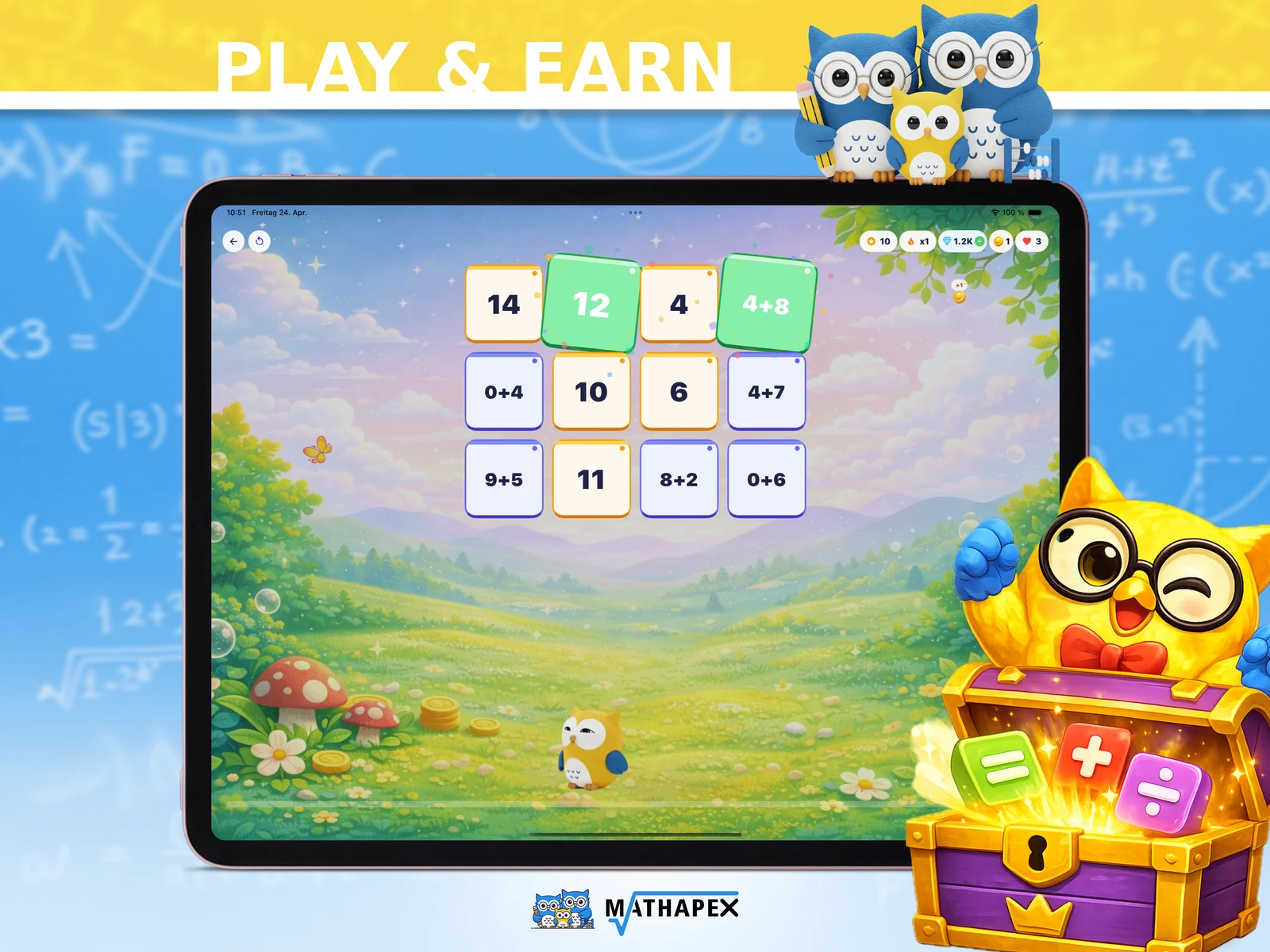
In the number-matching activity pictured above, one card might show 4 + 8 and another 12. The match works because 4 + 8 = 12. A child could count on from 8, or notice that 4 + 6 = 10 and the remaining 2 make 12. Both routes reach the same answer and give you something useful to talk about.
Another pair could be 9 + 5 and 14: 9 + 1 = 10, then 4 more make 14. After a match, ask, “How did you know those cards belonged together?” That one question brings the reasoning into view. If the answer was a guess, work it out together with fingers, counters or a quick drawing. The cards are an invitation to practise the idea, not a substitute for understanding it.
Respond to mistakes without making them the story
Children notice an adult’s reaction to a wrong answer. You do not need to pretend every answer is right. Try a calm prompt that keeps the problem open:
- “What do you know already?”
- “Could we make ten first?”
- “Let’s check that match together.”
For 4 + 8, you could move four counters next to eight and count the total, or split eight into six and two. Then return to the card and let your child make the match. The correction has become a way of checking, not a label for the child. Praise the specific thinking you saw—“You found a way to make ten”—rather than calling them “a math genius” or measuring them against someone else.
Try a short, low-pressure routine
Five to ten minutes is enough for a useful start. Let your child choose between a game and a focused practice activity, then agree to stop after one round. Play alongside them if they want company. Ask one question about their strategy, not a question after every move. End by naming something they worked out, even if the round was not perfect.
If a screen is not right for that moment, make two sets of paper cards: equations on one set and answers on the other. Start with 3 + 2, 4 + 4 and 6 + 3, paired with 5, 8 and 9. Turn them face down for a memory game, or leave them face up so the first challenge is the math rather than remembering card positions. Check each pair aloud before putting it aside.
Choose an activity that fits the child
The illustrated tablet activity is a MathApex mobile memory-style game. On the web, MathApex Games offers short activities such as Quick Math and Find the Number. If your child would rather work steadily through a single topic, use addition practice instead. You can switch between play and focused practice without treating one as a reward for enduring the other.
Watch for the moment a game stops helping. If your child is tired, frustrated or guessing rapidly, take a break or simplify the task. A good session leaves room for curiosity: “Can you show me another way?” That is a better reason to come back tomorrow than pressure to finish one more level.