
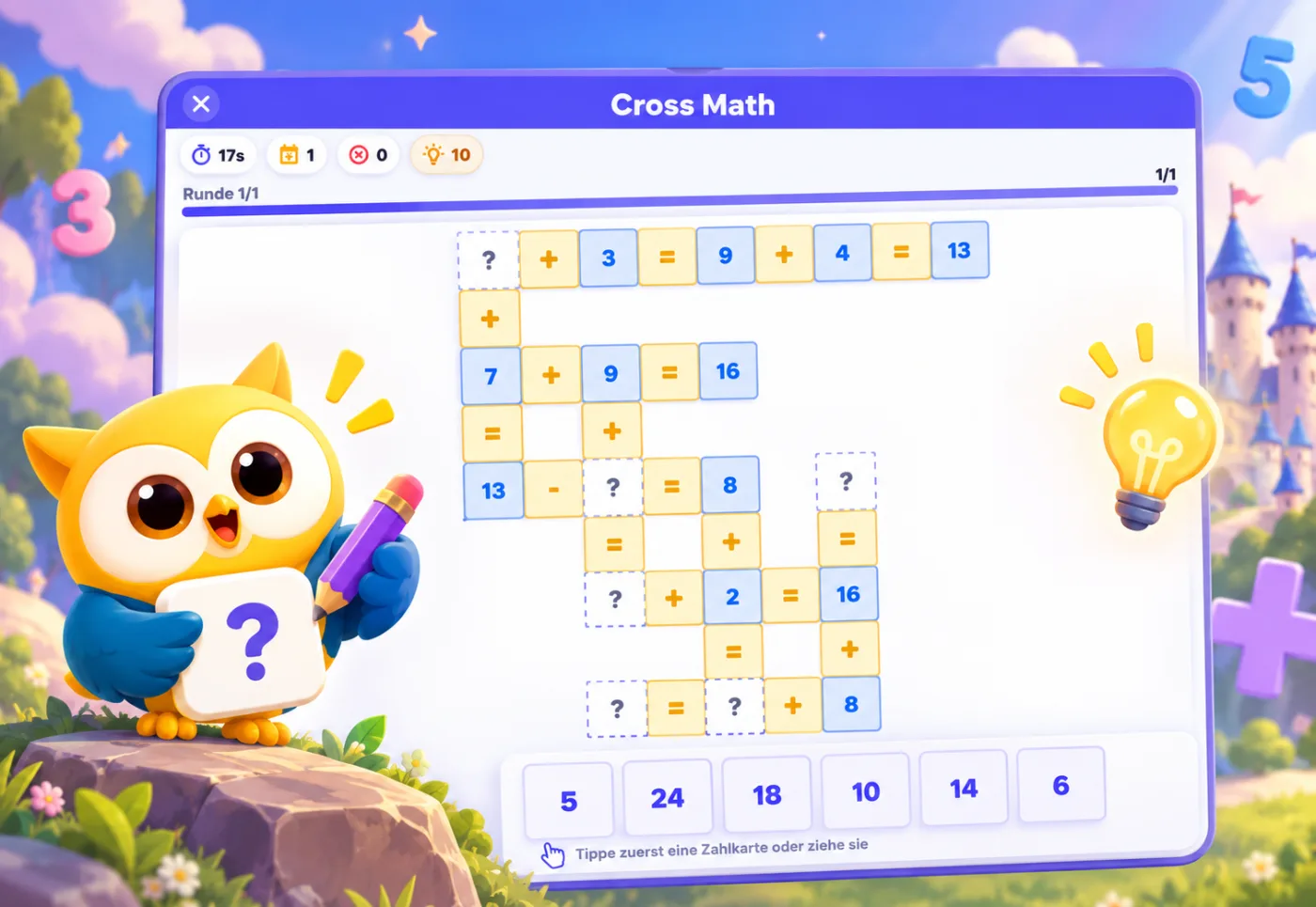
The best math puzzles for kids do more than hide a calculation behind a colorful screen. Cross Math creates a number crossword in which horizontal and vertical equations share tiles. Filling one blank can affect more than one equation, so children need to calculate, compare clues and check that each choice works in every direction.
That small change turns a set of arithmetic facts into a reasoning task. The illustration above shows the idea in a German-language game interface: number tiles sit beside a connected path of addition and subtraction equations. This guide explains how to solve that kind of puzzle, gives a clean worked example and shows adults how to help without taking over.
What is a Cross Math puzzle?
Cross Math combines the layout of a crossword with arithmetic. Numbers take the place of letters, and every completed row or column must form a true equation, such as:
6 + 3 = 9
A shared number may belong to two equations. It therefore has to satisfy both clues, not just the first one a child notices. That is what makes a math crossword different from an ordinary page of addition questions: the equations form a connected system.
MathApex uses addition and subtraction in the easy difficulty. More advanced options can also introduce multiplication and division. A beginner does not need the largest board or fastest timer. A small puzzle with one or two blanks gives children room to learn the solving method first.
How to solve Cross Math step by step
There is no rule that says a solver must begin in the top-left corner. A better strategy is to find the equation with the most information already visible.
- Look for a nearly complete equation. A row with one blank is usually the strongest starting clue.
- Use the inverse operation. For
□ + 3 = 9, calculate9 − 3 = 6. - Check the crossing equation. If the 6 is shared by a vertical line, it must make that equation true as well.
- Place a tile only when both directions agree. A number that works in one row may still fail at the crossing.
- Recalculate the whole board. Verify every complete row and column before finishing.
This sequence replaces random trial and error with a repeatable method. When a child gets stuck, ask, “Which equation has only one missing number?” That prompt keeps the thinking with the child.
A worked missing-number example
Consider two connected equations based on the upper part of the illustration:
□ + 3 = 9
9 + 4 = 13
The second equation confirms that 9 is the shared value. To find the first blank, work backwards: 9 − 3 = 6. We can then check the completed equation: 6 + 3 = 9.
Subtraction can ask for a missing part rather than the final answer:
13 − □ = 8
The missing number is the difference between 13 and 8. Since 13 − 5 = 8, the tile is 5. If that tile also belongs to another equation, the solution is not finished until the second equation checks out.
Ask a child to say the check aloud: “I chose 6 because 6 plus 3 equals 9.” Explaining the relationship is more useful than placing a correct tile by chance.
What skills can a number crossword practise?
A short Cross Math puzzle can bring several habits together:
- recalling addition and subtraction facts,
- recognizing inverse relationships,
- finding a missing addend or subtrahend,
- holding more than one condition in mind,
- checking work and locating an error.
The puzzle is practice, not a replacement for clear instruction. If □ + 3 = 9 is still confusing, pause and model it with counters or use focused addition practice. If equations such as 13 − □ = 8 need more attention, the subtraction practice page provides a calmer single-skill setting.
How parents can help without giving the answer
Useful prompts point to a strategy rather than a tile:
- “Where can you see only one blank?”
- “Could an inverse operation help?”
- “Does your number work in the other direction too?”
Remove the timer while the rules are new. Speed can make a familiar game exciting later, but it should not crowd out careful reasoning. If a child begins guessing, reveal another clue or use a smaller board. If the puzzle feels easy, ask for an explanation or invite the child to design a two-line number crossword on paper.
For an offline version, draw two equations that cross at one shared number. Start with □ + 4 = 10, then build a second correct equation around the 6. The worksheet generator can provide additional arithmetic practice before or after the puzzle.
Where Cross Math fits in a short practice routine
Five to ten focused minutes can be enough. End the round with a reflection question: “Which clue helped you first?” This shifts attention from score and speed to the reasoning that made the solution possible.
The hero image represents Cross Math from the MathApex game world; the interface shown in the illustration is German. Cross Math itself is available in the MathApex app. On the web, MathApex Games offers other short activities, while the practice pages let a child stay with one operation. That distinction keeps the next step clear for families.
Cross Math questions parents often ask
What age is Cross Math for?
The number range matters more than a fixed age. Children should already understand the operations used on the board. Small numbers, addition and subtraction, and one missing tile make a gentle starting point. Larger numbers and extra operations increase the challenge.
What if more than one number seems possible?
Check every equation that touches the blank. A candidate is only valid when all connected rows and columns are true. The need to coordinate those clues is the central reasoning challenge in Cross Math.