
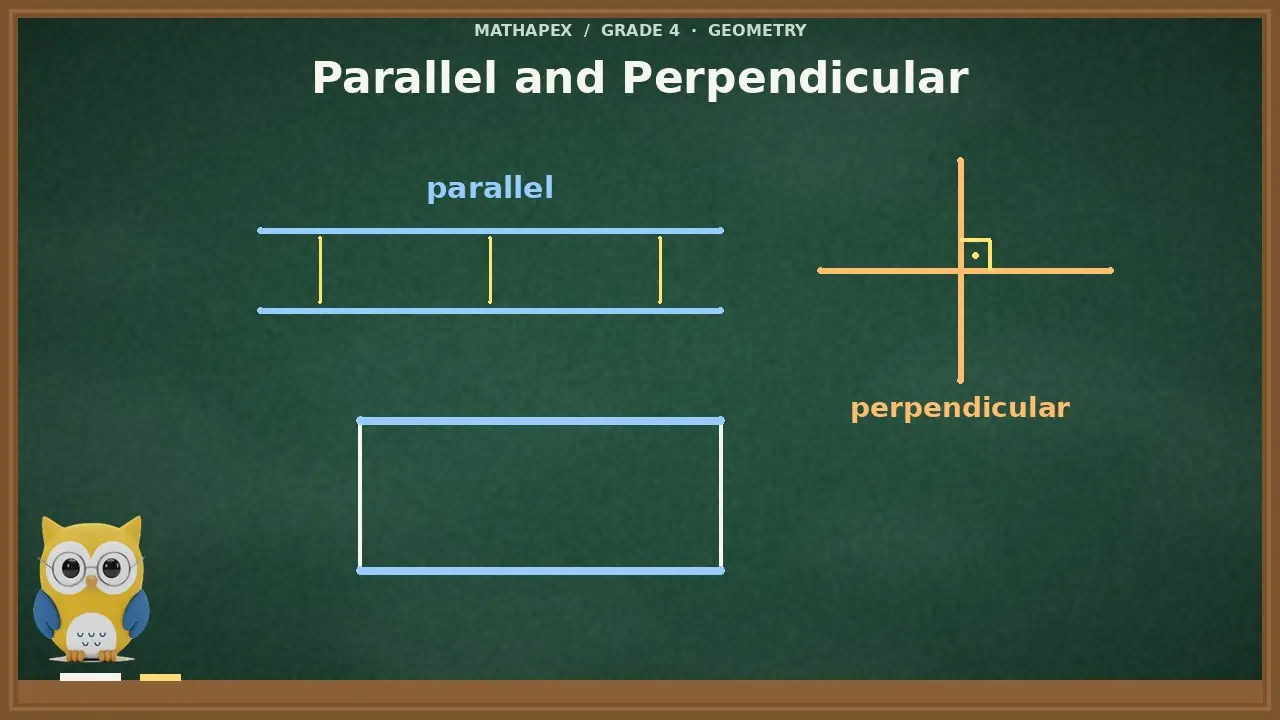
Two lines are parallel if they stay the same distance apart everywhere, so they never meet, like the two rails of a train track. Two lines are perpendicular if they meet or cross at a right angle, exactly 90 degrees. Any other pair of lines is neither parallel nor perpendicular.
Those three cases are enough to describe many shapes precisely: a rectangle has two pairs of parallel sides and four right angles. This article walks through that example, shows how kids can hunt for right angles at home, and explains how to draw both kinds of lines accurately with a ruler and a set square.
Parallel, perpendicular, or neither?
- Parallel: the distance between the lines is the same at every point. Even if you extend them forever, they never meet.
- Perpendicular: the lines meet or cross and form a right angle. In drawings, the right angle is marked with a small square in the corner.
- Neither: the lines cross at a slant, or they slowly get closer and would meet somewhere if you kept drawing.
The third case is easy to forget, and it matters. Two lines that look almost parallel but slowly close in are not parallel. Measure the gap in two places: if the two measurements differ, the lines will meet eventually.
Worked example: the rectangle
Label the sides of a rectangle a, b, c, and d: a on top, b on the right, c on the bottom, d on the left.
- a and c are opposite each other and the same distance apart everywhere, so a ∥ c.
- b and d are too, so b ∥ d.
That makes two pairs of parallel sides. The symbol ∥ is read “is parallel to.”
Sides that share a corner are perpendicular, for example a and b. Because that is true at every corner, a rectangle has four right angles. The same goes for a square. A triangle, on the other hand, can have at most one right angle.

Hunting for right angles at home
Right angles are everywhere: the corners of a book, a window, a door, a tabletop. Kids don’t need a special tool to check them. The corner of an index card is a right angle, and so is a homemade one: fold a sheet of paper once, then fold that crease onto itself. If the paper corner fits a corner exactly, that corner is a right angle.
Parallel lines are just as easy to find: the lines on notebook paper, the rungs of a ladder, the long edges of a ruler.
A right angle is also exactly a quarter turn. When the minute hand moves from the 12 to the 3, it turns 90 degrees. The video Quarter Turns builds on that idea.
Drawing them with a ruler and set square
A set square is a plastic triangle with one right-angled corner. Together with a ruler, it draws both kinds of lines accurately. (At home, a sturdy index card can stand in for the set square.)
To draw a perpendicular line:
- Line up one edge of the right-angled corner exactly along the given line.
- Slide the set square along the line until the other edge of the corner passes through the point where the new line should go.
- Draw along that second edge. The new line is perpendicular to the first.
To draw a parallel line:
- Lay one edge of the set square exactly along the given line.
- Press the ruler against another edge of the set square and hold the ruler still.
- Slide the set square along the ruler and draw along the first edge. Because the set square moved without turning, the new line is parallel to the first.
To check, measure the gap between parallel lines in two places, or test a right angle with the index-card corner. A sharp pencil helps more than you might think: a thick line throws off the measurement.
Common mistakes
- Mixing up “perpendicular” and “vertical.” Vertical means straight up and down. Perpendicular describes how two lines meet: two slanted lines can be perpendicular to each other if they form a right angle.
- Missing slanted parallel lines. Many kids only recognize parallel lines when they run straight across the page. Turn the page: parallel stays parallel, whatever direction the lines point.
- Forgetting “neither.” Not every pair of lines is parallel or perpendicular.
- Drawing by eye. A freehand “perpendicular” is almost never exactly 90 degrees. The set square makes the difference.
Keep practicing
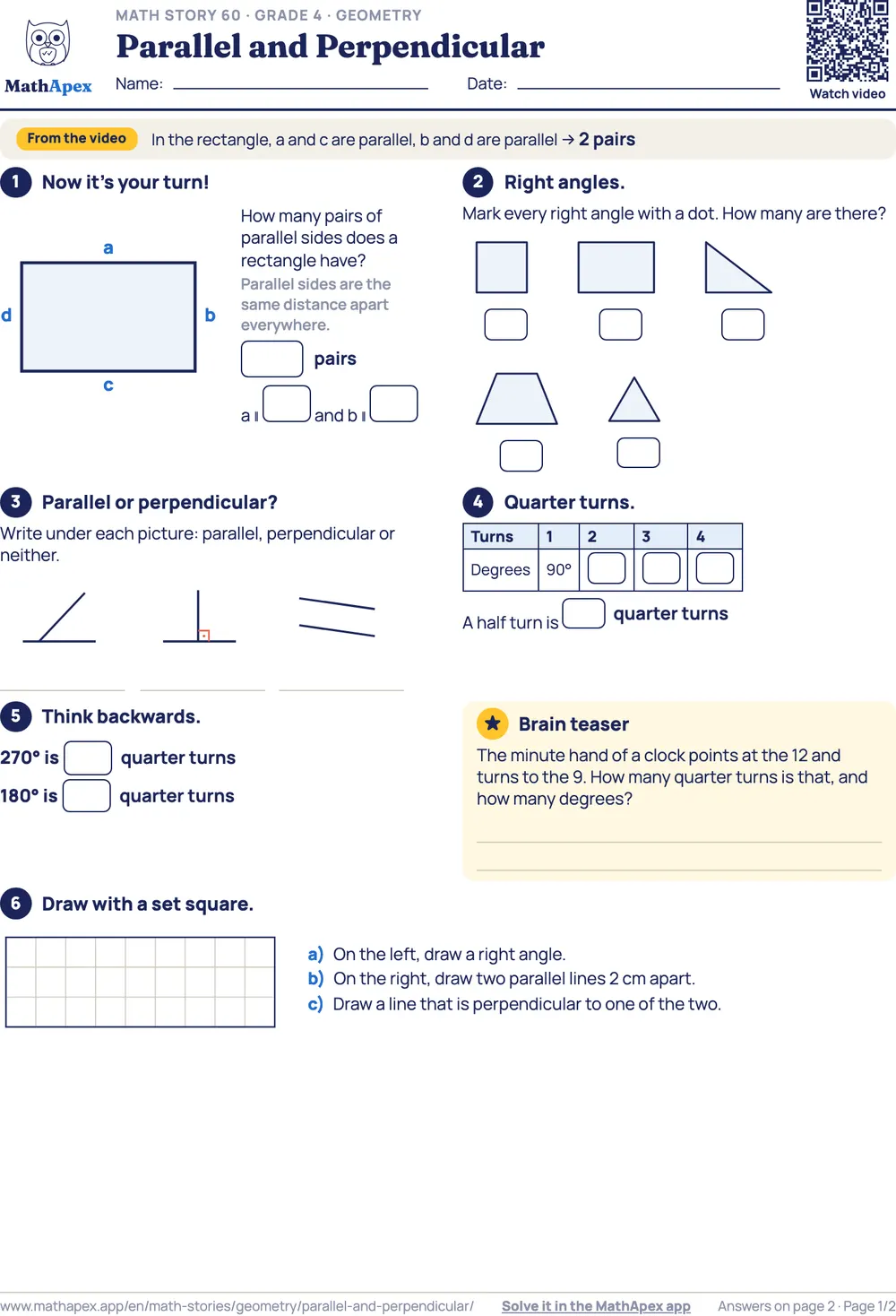
The video Parallel and Perpendicular tells the rectangle example as a short story, and The Right Angle shows how to check right angles with a set square. To go with them, there are grade 4 geometry worksheets with answers on parallel and perpendicular lines: counting pairs of parallel sides, marking right angles, sorting line pairs into parallel, perpendicular, or neither, and drawing with a set square.
A good closing question: “How do you know these two lines are parallel?” A child who answers “they’re the same distance apart everywhere” has the key idea.