

To find the perimeter of an L-shape, first work out the missing side lengths, then add all six sides. There is also a shortcut: an L-shape has the same perimeter as the rectangle drawn around it. For an L-shape that fits inside a 10 cm by 6 cm rectangle, the perimeter is 2 × (10 + 6) = 32 cm, no matter how big the missing corner is.
Below is a full worked example, the reason the shortcut works (and when it does not), a quick review of rectangles, squares, and triangles, and the mistakes kids make most often.
What perimeter means
Perimeter is the distance all the way around a shape. Picture an ant walking once along the edge, or the fence around a yard: that path is the perimeter. The one rule that matters most is that every side is counted exactly once.
On grid paper, younger kids can trace the edge with a finger and count as they go. Shortcuts make sense once that tracing is solid.
Worked example: the L-shape
An L-shape is a rectangle with a smaller rectangle cut out of one corner. It has six sides, and worksheets usually label only four of them.
Take an L-shape that fits inside a rectangle 10 cm wide and 6 cm tall, with a piece missing from the top right corner. The labeled sides are:
- bottom: 10 cm
- left: 6 cm
- top: 6 cm
- the short vertical step: 2 cm
Two sides are missing:
- right side: the full height is 6 cm, and the step takes away 2 cm, so 6 − 2 = 4 cm.
- horizontal step: the full width is 10 cm, and the top side is 6 cm, so 10 − 6 = 4 cm.
Now add all six sides: 10 + 4 + 4 + 2 + 6 + 6 = 32 cm.
The shortcut: same perimeter as the rectangle around it
Compare that with the rectangle around the shape: 2 × (10 + 6) = 32 cm. Same answer, and here is why.
Imagine sliding the two inside edges of the step outward. The horizontal step (4 cm) fills the gap in the top edge, turning 6 cm into 10 cm. The vertical step (2 cm) fills the gap on the right, turning 4 cm into 6 cm. Nothing is added and nothing is lost, so the distance around stays the same. The frame above shows the same idea with a smaller shape: 6 + 4 + 6 + 4 = 20 cm.
The shortcut works only when the missing piece is at a corner. If the notch is in the middle of a side, it adds two extra sides, and the perimeter grows. A notch 2 cm wide and 3 cm deep in the middle of the top edge of the same rectangle gives 32 + 3 + 3 = 38 cm.
Rectangles, squares, and triangles
Rectangle: opposite sides are equal, so add the length and width once, then double it. A rectangle 8 cm long and 3 cm wide has a perimeter of 2 × (8 + 3) = 2 × 11 = 22 cm.
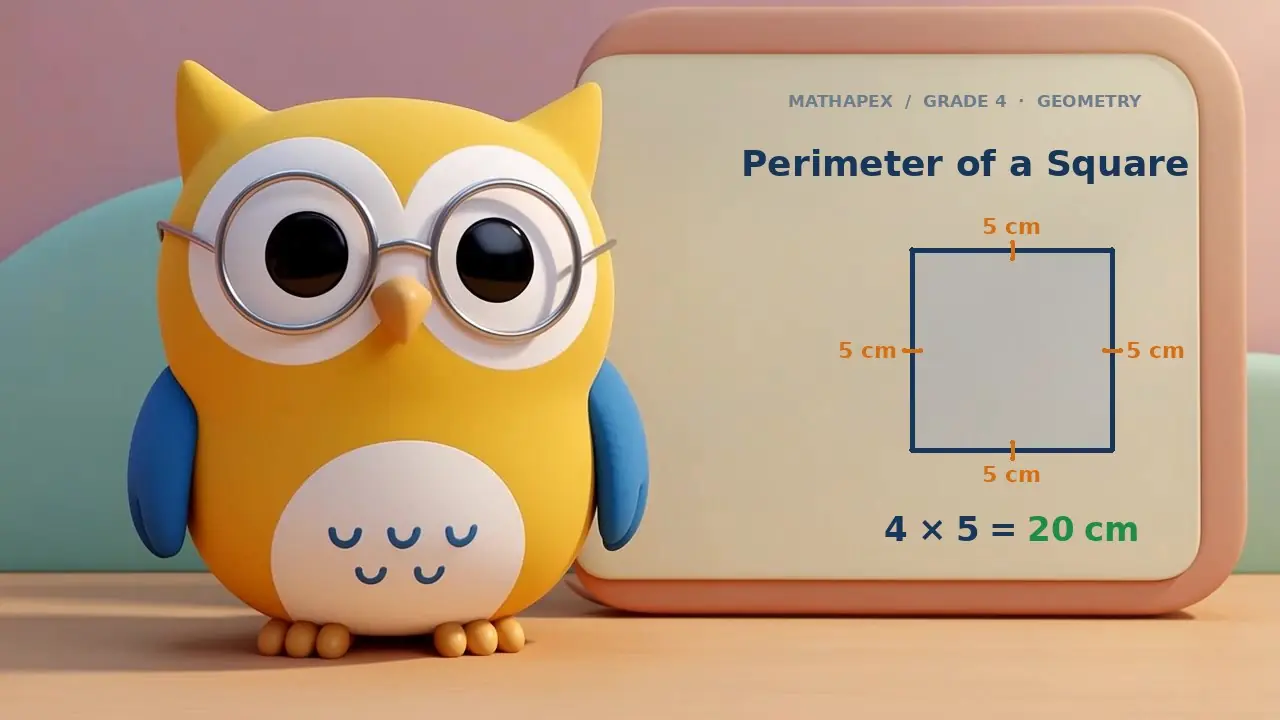
Square: all four sides are equal. With 6 cm sides, the perimeter is 4 × 6 = 24 cm.
Triangle: there is no shortcut that always works, so add the three sides. A triangle with sides of 3 cm, 4 cm, and 5 cm has a perimeter of 3 + 4 + 5 = 12 cm. If all three sides are equal, multiply one side by 3.
Perimeter or area?
Perimeter measures the edge; area measures the space inside. The 8 cm by 3 cm rectangle has a perimeter of 22 cm but an area of 8 × 3 = 24 square centimeters, which is 24 little squares that are 1 cm on each side. The units give it away: centimeters for perimeter, square centimeters (cm²) for area. The video Area shows how to count area with squares.
Common mistakes
- Adding only two sides. 8 + 3 = 11 is only half the perimeter of the rectangle. The doubling is missing.
- Skipping a side. This happens most with L-shapes. Put a small check mark on each side as you add it.
- Mixing units. 2 m and 50 cm can’t be added as they are. Convert first: 200 cm + 50 cm = 250 cm.
- Mixing up perimeter and area. Length times width gives the area of a rectangle, not its perimeter.
Keep practicing
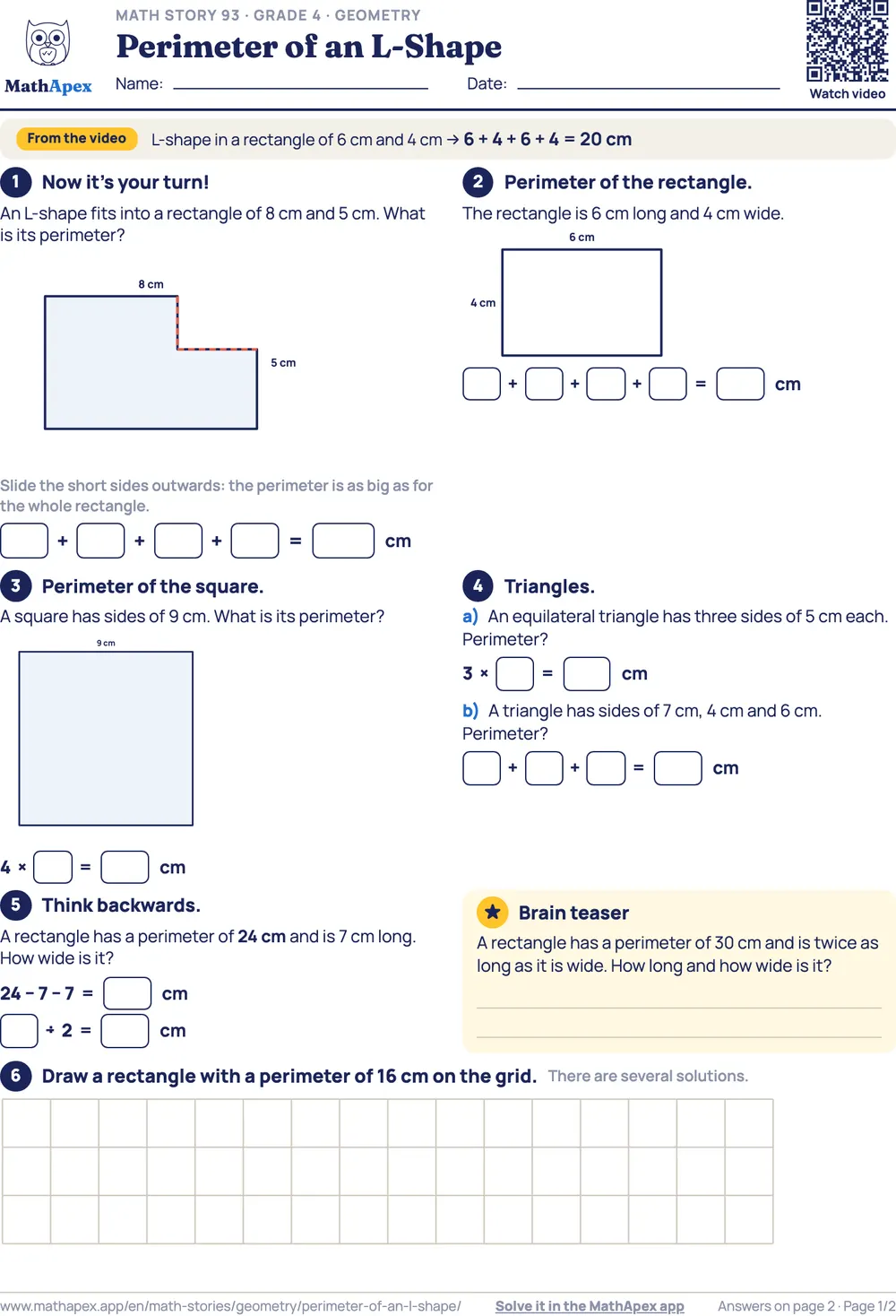
The videos Perimeter of an L-Shape, Perimeter of a Rectangle, Perimeter of a Square, and Perimeter of a Triangle each tell one case as a short story. To go with them, there are grade 4 geometry worksheets with answers on perimeter: L-shapes, rectangles, squares, triangles, and working backward from the perimeter to a missing side.
A good closing question for any shape: “How many sides does it have, and did you count each one exactly once?”